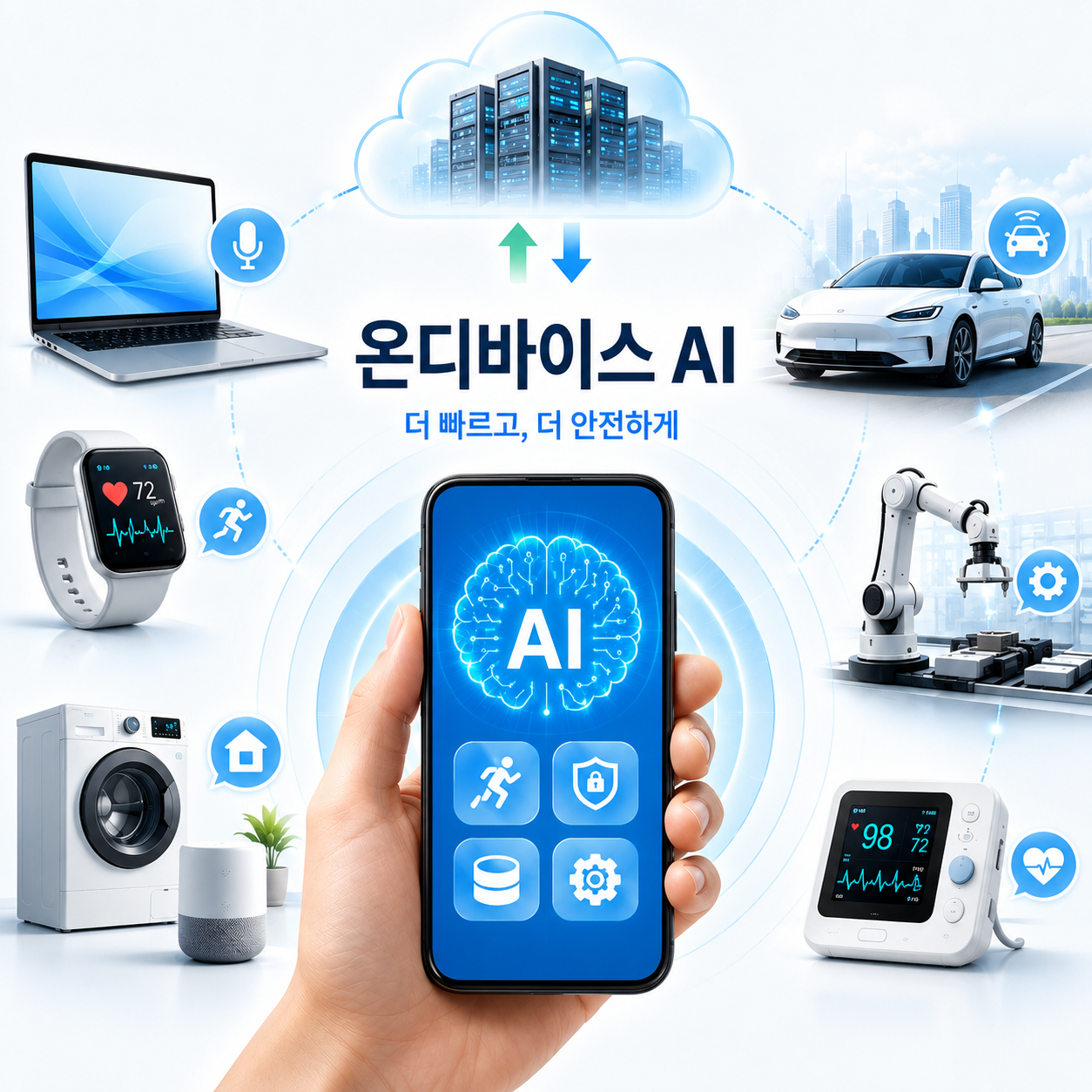
AI는 더 이상 거대한 데이터센터 안에서만 작동하는 기술이 아니다. 스마트폰과 노트북, 자동차와 가전, 공장 설비와 의료기기 안으로 들어와 더 빠르고 조용하게 일하기 시작했다. 속도와 비용, 프라이버시라는 세 가지 요구가 맞물리면서 온디바이스 AI는 다음 단계의 인공지능 질서를 여는 핵심 기술이 되고 있다.
[Key Message]
* 온디바이스 AI는 인공지능의 중심을 클라우드에서 스마트폰, 노트북, 자동차, 가전, 공장 장비 같은 개인 기기와 현장 장비로 옮기는 흐름이다.
* AI가 일상 기능으로 확산될수록 모든 데이터를 클라우드로 보내 처리하는 방식은 비용, 전력, 지연 시간, 보안 부담을 키운다.
* 온디바이스 AI의 가장 큰 강점은 빠른 반응이다. 자동차의 위험 감지, 공장의 불량 검사, 의료기기의 이상 신호 감지처럼 즉각적 판단이 중요한 영역에서 특히 가치가 커진다.
* 개인정보 보호는 온디바이스 AI 확산의 핵심 동력이다. 사용자의 사진, 음성, 위치, 건강 정보, 업무 문서 같은 민감한 데이터를 기기 안에서 처리할 수 있기 때문이다.
* 앞으로 AI 경쟁은 더 큰 모델을 만드는 것만이 아니라, 더 작고 빠르며 안전한 AI를 기기 안에서 자연스럽게 작동시키는 능력으로 이동할 것이다.
***
데이터센터가 감당하지 못하는 AI의 일상화
처음 생성형 AI가 등장했을 때 사람들은 화면 안에서 벌어지는 마술에 가까운 경험에 먼저 놀랐다. 질문을 넣으면 긴 문장이 돌아오고, 몇 줄의 설명만으로 이미지가 만들어지고, 회의 내용을 정리하거나 번역하거나 보고서 초안을 쓰는 일이 순식간에 가능해졌다. 이전까지 인공지능은 연구소, 대기업, 기술 전문가의 언어에 가까웠지만, 생성형 AI는 그 경계를 무너뜨렸다. 누구나 검색창을 쓰듯 AI에게 말을 걸고, 누구나 메신저를 쓰듯 AI와 대화를 나누는 시대가 열린 것이다.
하지만 이 편리한 경험의 뒤에는 무거운 구조가 숨어 있다. 사용자가 스마트폰이나 노트북에서 AI에게 질문을 던지면, 그 내용은 대개 멀리 떨어진 클라우드 서버로 이동한다. 서버는 거대한 데이터센터 안에서 연산을 수행하고, 다시 결과를 사용자의 화면으로 돌려보낸다. 사용자의 눈에는 몇 초 만에 문장이 나타나는 것처럼 보이지만, 그 짧은 시간 동안 전력과 냉각 설비, 서버 장비와 네트워크가 동시에 움직인다. AI의 대답 하나에는 보이지 않는 비용과 에너지가 붙어 있다.
문제는 AI 사용이 점점 특별한 일이 아니라 일상적인 일이 되고 있다는 점이다. 과거에는 가끔 궁금한 것을 물어보거나 문서 초안을 작성할 때 AI를 썼다면, 앞으로는 문서 프로그램, 이메일, 사진 앱, 회의 도구, 고객센터, 검색, 번역, 교육, 의료, 자동차, 공장 설비 곳곳에 AI가 기본 기능처럼 들어간다. 하루에 몇 번 쓰는 도구가 아니라 하루 종일 작동하는 보이지 않는 조력자가 되는 것이다. 그렇게 되면 모든 명령과 데이터를 클라우드로 보내 처리하는 방식은 점점 부담스러워진다.
기업도 같은 고민에 부딪힌다. 처음에는 AI가 생산성을 얼마나 높일 수 있는지가 중요했다. 하지만 실제 업무에 깊이 도입되면 질문은 달라진다. 직원 수천 명이 매일 AI를 사용하고, 고객 응대와 문서 작성, 내부 검색과 데이터 분석까지 AI가 맡게 되면 비용은 눈덩이처럼 커질 수 있다. AI가 많이 쓰일수록 돈이 더 들고, 데이터센터 의존도가 높아지고, 네트워크 지연과 보안 우려도 함께 커진다. 편리함이 커질수록 구조적 피로도 함께 커지는 셈이다.
온디바이스 AI는 이 피로감 속에서 등장한 흐름이다. 말 그대로 AI 연산의 일부를 사용자의 기기 안에서 직접 처리하는 방식이다. 스마트폰이 사용자의 음성을 알아듣고, 노트북이 회의 내용을 요약하고, 자동차가 보행자를 감지하고, 공장 장비가 불량품을 판별하는 일을 꼭 먼 서버에 맡기지 않는 것이다. AI가 구름 위의 클라우드에서 내려와 손안의 기기와 현장의 장비 안으로 들어오기 시작했다.
이 변화는 단순히 처리 장소가 바뀌는 문제가 아니다. AI 산업의 경제성이 달라지고, 개인정보 보호의 기준이 달라지며, 반도체와 운영체제, 스마트폰과 PC, 자동차와 가전의 경쟁 구도까지 바뀐다. 지금까지 AI 경쟁의 중심이 누가 더 큰 모델을 만들고 더 많은 데이터를 학습시키는가에 있었다면, 앞으로는 누가 더 작고 빠르고 안전하게 AI를 작동시키는가도 중요한 기준이 된다. 인공지능의 다음 승부는 거대한 두뇌를 만드는 경쟁만이 아니라, 그 두뇌를 얼마나 가까운 곳에 심을 수 있는가의 경쟁이기도 하다.
손안으로 내려온 인공지능
온디바이스 AI를 이해하는 가장 쉬운 방법은 스마트폰을 떠올리는 것이다. 오늘날 스마트폰은 이미 많은 판단을 스스로 한다. 사진을 찍으면 얼굴과 배경을 구분하고, 어두운 곳에서는 자동으로 밝기를 보정하며, 키보드는 사용자가 쓰려는 단어를 미리 제안한다. 음성을 텍스트로 바꾸고, 사진 속 글자를 읽고, 잠금 화면에서 얼굴을 알아보는 기능도 익숙하다. 이런 기능들은 모두 AI가 사용자의 기기 안에서 조용히 작동해온 사례다.
최근의 변화는 여기에 생성형 AI의 기능까지 들어오기 시작했다는 데 있다. 예전의 온디바이스 AI가 사진 보정이나 음성 인식처럼 비교적 제한된 기능에 가까웠다면, 이제는 문장 요약, 실시간 번역, 이미지 생성 보조, 회의록 정리, 개인 맞춤형 추천처럼 더 넓은 기능이 기기 안으로 들어오고 있다. 스마트폰과 노트북은 단순한 입력 장치가 아니라 사용자의 상황을 이해하고 일부 판단을 직접 수행하는 작은 AI 작업장이 되고 있다.
PC의 변화도 상징적이다. 과거의 PC는 문서를 작성하고 파일을 저장하고 인터넷에 접속하는 도구였다. 성능 좋은 PC란 프로그램이 빠르게 열리고, 영상 편집이 부드럽고, 게임이 잘 돌아가는 기계에 가까웠다. 그러나 AI PC의 등장은 PC의 의미를 바꾼다. 이제 PC는 문서를 쓰는 도구를 넘어 문서의 맥락을 이해하는 도구가 된다. 회의 중 흘러나오는 음성을 정리하고, 영상 통화에서 배경 소음을 줄이며, 화면 속 정보를 해석하고, 사용자가 다음에 해야 할 작업을 도와주는 방향으로 이동한다.
이 과정에서 중요한 것이 AI 전용 칩이다. 일반적인 중앙처리장치나 그래픽처리장치만으로도 AI 작업을 처리할 수 있지만, 전력과 효율 면에서는 한계가 있다. 그래서 최근의 스마트폰과 노트북에는 AI 연산에 특화된 신경망처리장치가 들어간다. 이 칩은 AI가 자주 수행하는 계산을 더 빠르고 적은 전력으로 처리하도록 설계된다. 쉽게 말해, 기기 안에 AI 전용 작업대를 따로 마련하는 셈이다.
스마트폰에서는 이 변화가 더 민감하다. 스마트폰은 사용자의 가장 사적인 기기다. 사진, 연락처, 위치, 메시지, 일정, 결제 정보, 건강 정보가 모두 들어 있다. 이 기기가 AI를 품는다는 것은 강력한 편리함을 뜻하지만, 동시에 개인정보 문제와 바로 맞닿는다. 사용자의 사진을 분석하고, 대화를 이해하고, 일정과 습관을 파악하는 AI가 모든 정보를 외부 서버로 보내야 한다면 사람들은 불안해질 수밖에 없다. 그래서 스마트폰 안에서 가능한 한 많은 AI 작업을 직접 처리하려는 흐름이 커지고 있다.
자동차도 마찬가지다. 도로 위에서 자동차가 위험을 감지하는 순간에는 망설일 시간이 없다. 앞차가 급정거하거나 보행자가 갑자기 나타나거나 차선이 흔들릴 때, 자동차가 먼 서버에 물어본 뒤 판단할 수는 없다. 차량 안의 센서와 칩이 즉시 주변 상황을 해석해야 한다. 이런 영역에서 온디바이스 AI는 편의 기능이 아니라 안전 기능이다. AI가 얼마나 가까운 곳에서, 얼마나 빠르게 판단하느냐가 사람의 생명과 연결될 수 있다.
가전과 웨어러블 기기도 온디바이스 AI의 무대가 된다. 로봇청소기는 집 구조와 생활 리듬을 이해하고, 에어컨은 실내 온도와 사용자의 습관을 반영해 움직이며, 스마트워치는 심박과 수면 패턴을 분석한다. 이런 정보는 모두 개인의 생활과 밀접하다. 모든 데이터를 외부로 보내지 않고 기기 안에서 처리할 수 있다면, 사용자는 더 편리하면서도 덜 불안한 경험을 얻을 수 있다.
결국 온디바이스 AI는 AI를 더 작게 만드는 기술이 아니다. AI를 더 가까이 가져오는 기술이다. 데이터가 생겨나는 곳, 판단이 필요한 순간, 사용자가 실제로 행동하는 공간에 AI가 머물게 하는 방식이다. 과거의 AI가 거대한 중앙 두뇌였다면, 온디바이스 AI는 그 두뇌의 일부를 수많은 기기와 현장으로 나누어 심는 과정에 가깝다.
느린 AI는 결국 쓰이지 않는다
AI의 성능을 말할 때 사람들은 흔히 정확도를 떠올린다. 답이 맞는가, 문장이 자연스러운가, 이미지를 잘 만드는가, 코드를 제대로 작성하는가가 중요해 보인다. 물론 맞다. 하지만 실제 사용 경험에서는 또 하나의 기준이 있다. 바로 속도다. 아무리 똑똑한 AI라도 반응이 늦으면 사람들은 금방 답답함을 느낀다.
스마트폰의 음성 명령을 생각해보면 쉽다. 사용자가 “방금 찍은 사진에서 문서만 찾아줘”라고 말했을 때 기기가 곧장 반응하면 자연스럽다. 하지만 매번 서버 연결을 기다리고, 네트워크 상태에 따라 몇 초씩 멈칫거리면 사용자는 그 기능을 자주 쓰지 않게 된다. AI가 일상 도구가 되려면 사용자는 AI를 기다린다고 느끼지 않아야 한다. 손가락으로 화면을 넘기는 것처럼, 말을 걸면 곧바로 반응해야 한다.
온디바이스 AI의 첫 번째 장점은 바로 이 지연 시간을 줄인다는 데 있다. 클라우드 AI는 사용자의 요청을 서버로 보내고, 서버에서 처리한 뒤 다시 결과를 받아야 한다. 네트워크가 빠르면 이 과정은 짧아지지만 완전히 사라지지는 않는다. 반면 기기 안에서 처리하는 AI는 이동 거리가 짧다. 사용자의 데이터가 기기 안에서 바로 분석되고, 결과가 곧장 화면에 나타난다. 아주 작은 차이처럼 보이지만, 반복 사용이 많아질수록 이 차이는 경험의 질을 크게 바꾼다.
공장에서는 속도가 곧 돈이다. 생산 라인에서 제품 하나가 지나갈 때마다 카메라가 표면을 찍고, AI가 불량 여부를 판단한다고 해보자. 모든 이미지를 클라우드 서버로 보내 분석한 뒤 결과를 받는 방식은 가능해 보이지만, 현장에서는 지연과 네트워크 불안정이 큰 문제가 된다. 판단이 늦어지면 불량품은 이미 다음 공정으로 넘어간다. 라인을 멈추는 타이밍이 늦어지면 손실도 커진다. 장비 안에서 바로 판단하는 AI는 이런 위험을 줄인다. 제조업에서 빠른 판단은 품질이고, 품질은 곧 비용 절감이다.
의료와 돌봄에서도 속도는 중요하다. 웨어러블 기기가 심박 이상, 낙상, 호흡 변화 같은 신호를 감지할 때 모든 데이터를 서버로 보낸 뒤 판단한다면 응급 상황에서 늦을 수 있다. 기기 자체가 먼저 위험 신호를 파악하고, 필요한 경우에만 보호자나 의료기관에 알리는 구조가 더 적합하다. 고령화가 진행될수록 이런 실시간 감지와 경고 기능은 더 중요해진다. 온디바이스 AI는 병원 밖의 일상 공간에서도 건강과 안전을 지키는 기술이 될 수 있다.
자동차는 속도의 의미를 가장 극적으로 보여준다. 도로 위에서는 1초가 길다. 앞차가 갑자기 멈추거나 보행자가 튀어나오는 상황에서 차량이 판단을 늦추면 사고로 이어질 수 있다. 이때 필요한 것은 거대한 서버의 장황한 분석이 아니라 차량 안에서 이루어지는 즉각적인 판단이다. 자동차의 카메라와 레이더, 센서가 주변을 읽고, 차량 내부의 AI가 위험을 해석하고, 제동이나 경고를 바로 실행해야 한다.
속도가 빨라지면 AI에 대한 기대도 달라진다. 사람들은 더 이상 “AI에게 물어보고 기다리는 경험”에 만족하지 않을 것이다. 문서를 열면 이미 요약이 준비되어 있고, 회의가 끝나면 회의록이 정리되어 있으며, 사진을 찍으면 필요한 정보가 자동으로 분류되고, 자동차는 위험을 미리 감지하는 경험이 자연스러워진다. 온디바이스 AI는 AI를 특별한 기능에서 기본 경험으로 바꾸는 기반이다.
AI를 많이 쓸수록 더 비싸지는 역설
AI는 생산성을 높여주는 기술로 주목받지만, 동시에 비용을 만드는 기술이기도 하다. 기업이 생성형 AI를 처음 도입할 때는 기대가 크다. 반복 업무를 줄이고, 직원들이 보고서와 이메일을 더 빨리 작성하고, 고객 상담이 자동화되고, 마케팅 콘텐츠 제작 시간이 줄어드는 장점이 눈에 들어온다. 그러나 사용이 본격화되면 계산표가 달라진다. AI는 많이 쓸수록 더 많은 연산을 요구하고, 연산은 결국 비용으로 돌아온다.
처음에는 몇몇 부서가 실험적으로 AI를 쓴다. 이때는 비용이 크게 보이지 않을 수 있다. 하지만 전사적으로 확산되면 상황이 달라진다. 모든 직원이 하루에도 여러 번 문서를 요약하고, 회의록을 만들고, 고객 데이터를 분석하고, 보고서 초안을 요청하면 사용량은 폭발적으로 늘어난다. 고객센터나 내부 검색, 영업 지원 시스템에 AI가 붙으면 사용자는 더 많아지고 요청은 더 자주 발생한다. AI가 업무의 기본 인프라가 될수록 클라우드 비용은 기업 경영에서 무시할 수 없는 항목이 된다.
온디바이스 AI는 이 비용 구조를 다시 짜는 방식이다. 모든 일을 클라우드에 맡기지 않고, 가볍고 반복적인 작업은 기기에서 처리한다. 간단한 문장 교정, 회의 음성의 1차 인식, 사진 분류, 기본 번역, 키워드 추천, 자주 쓰는 문서 형식 정리 같은 일은 반드시 거대한 서버가 필요하지 않을 수 있다. 이런 작업을 기기 안에서 처리하면 서버 사용량과 데이터 전송량을 줄일 수 있다.
물론 모든 작업을 기기에서 처리할 수는 없다. 방대한 자료를 바탕으로 긴 보고서를 쓰거나, 복잡한 법률 문서를 분석하거나, 여러 시스템의 데이터를 종합해 전략을 세우는 일은 여전히 클라우드의 강력한 연산 능력이 필요하다. 중요한 것은 역할 분담이다. 가벼운 일은 가까운 곳에서 처리하고, 무거운 일은 큰 서버로 보내는 구조다. 이렇게 하면 사용자는 빠른 경험을 얻고, 기업은 비용을 더 효율적으로 관리할 수 있다.
이 변화는 기업의 IT 전략에도 영향을 준다. 예전에는 클라우드 계약과 서버 인프라가 AI 도입의 핵심이었다. 앞으로는 직원들이 사용하는 노트북과 스마트폰, 업무용 단말기 자체가 AI 전략의 일부가 된다. 어떤 기기를 지급할 것인지, 어느 정도의 AI 연산 능력을 갖춘 장비를 쓸 것인지, 어떤 업무는 기기 안에서 처리하고 어떤 업무는 클라우드로 보낼 것인지가 중요한 의사결정이 된다.
공공기관과 금융회사, 병원, 법률회사, 제조기업은 특히 이 문제에 민감하다. 이들은 민감한 데이터를 다룬다. 고객의 금융 기록, 환자의 진료 정보, 계약서, 연구개발 자료, 공장 생산 데이터는 외부 서버로 쉽게 보낼 수 없다. AI를 쓰고 싶지만 데이터 이동이 부담스러운 조직에는 온디바이스 AI와 내부 시스템을 결합한 방식이 더 현실적이다. 생산성과 보안을 동시에 고려해야 하는 곳일수록 온디바이스 AI의 의미가 커진다.
AI 시대의 비용은 단지 돈의 문제가 아니다. 전력과 탄소, 네트워크와 보안, 서버 증설과 운영 인력까지 모두 포함한다. 모든 AI 작업을 중앙의 데이터센터로 몰아넣는 방식은 언젠가 한계에 부딪힐 수밖에 없다. 온디바이스 AI는 그 부담을 나누는 기술이다. AI를 더 많이 쓰기 위해서는 오히려 AI를 더 가까운 곳에서, 더 작고 효율적으로 돌릴 필요가 있다.
프라이버시가 성능만큼 중요한 기준이 되다
온디바이스 AI의 확산을 밀어 올리는 또 하나의 힘은 프라이버시다. AI가 똑똑해지려면 사용자를 더 잘 알아야 한다. 사용자의 말투와 습관, 사진과 일정, 위치와 취향, 업무 문서와 대화 맥락을 이해할수록 AI는 더 개인화된 도움을 줄 수 있다. 하지만 바로 그 이유 때문에 AI는 불안한 기술이 되기도 한다. 편리함을 얻기 위해 너무 많은 정보를 내줘야 한다면, 사람들은 쉽게 마음을 열지 않는다.
스마트폰을 생각해보자. 스마트폰 속에는 한 사람의 생활이 거의 통째로 들어 있다. 가족사진, 친구와의 대화, 은행 앱, 병원 예약, 이동 경로, 검색 기록, 메모, 업무 파일까지 모두 담겨 있다. AI가 이 정보를 잘 활용하면 놀라운 편리함을 제공할 수 있다. 하지만 이 데이터가 계속 외부 서버로 올라가고, 어디에서 어떻게 처리되는지 알 수 없다면 불안은 커진다. 사용자는 더 똑똑한 AI를 원하지만, 자신의 삶 전체가 서버에 노출되는 것은 원하지 않는다.
온디바이스 AI는 이 모순을 줄인다. 기기 안에서 처리할 수 있는 정보는 기기 안에 머물게 하는 방식이다. 예를 들어 스마트폰이 사진 속 문서를 찾아주거나, 노트북이 회의 내용을 요약하거나, 키보드가 문장을 추천할 때 모든 원본 데이터를 외부로 보내지 않아도 된다면 사용자의 부담은 줄어든다. 기기 안에서 먼저 판단하고, 꼭 필요한 경우에만 제한적으로 외부 연산을 활용하는 구조가 가능해진다.
이제 프라이버시는 부가 기능이 아니라 제품 경쟁력이다. 과거에는 스마트폰을 고를 때 카메라 화질, 화면 크기, 배터리, 저장공간을 주로 따졌다. 앞으로는 “내 데이터가 어디에서 처리되는가”도 중요한 기준이 된다. 사진을 분석할 때 그 사진이 서버로 올라가는지, 회의 내용을 요약할 때 음성이 저장되는지, AI 비서가 내 일정을 읽을 때 그 정보가 외부 기업의 시스템과 연결되는지가 소비자의 신뢰를 좌우할 수 있다.
기업에서는 이 문제가 더 직접적이다. 회사의 회의록, 계약서, 고객 정보, 재무 자료, 기술 문서가 외부 AI 서버로 흘러가는 구조는 큰 부담이다. 아무리 편리한 AI라도 보안 정책을 통과하지 못하면 실제 업무에 쓰기 어렵다. 그래서 기업들은 “AI를 쓸 것인가”뿐 아니라 “어떤 데이터는 절대 밖으로 보내지 않을 것인가”를 함께 고민한다. 온디바이스 AI는 이런 조직에 더 안전한 선택지를 제공한다.
교육과 의료, 금융, 국방, 공공행정 분야에서는 프라이버시 요구가 더욱 강하다. 학생의 학습 기록, 환자의 건강 정보, 개인의 신용 정보, 국가 안보와 관련된 자료는 민감성이 높다. 이 영역에서 AI가 확산되려면 단순히 성능이 뛰어나다는 주장만으로는 부족하다. 데이터가 어디에서 처리되고, 누가 접근할 수 있으며, 기록이 남는지 지워지는지에 대한 신뢰가 필요하다. 온디바이스 AI는 이런 신뢰를 설계하는 한 방법이다.
물론 기기 안에서 처리한다고 해서 모든 문제가 사라지는 것은 아니다. 기기 자체가 해킹될 수 있고, 사용자가 어떤 데이터가 AI에 의해 처리되는지 알지 못하면 또 다른 위험이 생긴다. 온디바이스 AI에도 투명한 설정, 명확한 권한 관리, 보안 업데이트, 책임 있는 설계가 필요하다. 하지만 데이터 이동을 줄이고 민감한 정보를 외부로 보내지 않는 선택지를 넓힌다는 점에서, 온디바이스 AI는 프라이버시 시대에 매우 중요한 기술 방향이다.
작은 모델이 여는 큰 시장
온디바이스 AI가 가능해지려면 AI 모델도 달라져야 한다. 거대한 데이터센터에서 작동하는 초대형 모델을 그대로 스마트폰이나 노트북에 넣을 수는 없다. 기기는 서버보다 작고, 배터리로 움직이며, 발열과 저장공간의 제약도 크다. 따라서 온디바이스 AI의 핵심은 단순히 AI를 기기 안으로 옮기는 것이 아니라, AI를 기기에 맞게 줄이고 가볍게 만들고 효율적으로 재설계하는 데 있다.
최근 AI 분야에서 모델 경량화가 중요해지는 이유가 여기에 있다. 어려운 기술 용어를 빼고 말하면, 핵심은 성능은 최대한 유지하되 크기와 연산량을 줄이는 것이다. 거대한 백과사전을 통째로 들고 다니는 대신, 자주 쓰는 지식과 기능을 잘 정리한 작은 수첩을 만드는 것과 비슷하다. 모든 질문에 완벽하게 답하지는 못하더라도, 일상적이고 반복적인 작업에는 충분히 빠르고 유용한 AI를 만드는 것이다.
사실 대부분의 일상 작업에는 항상 가장 큰 AI가 필요하지 않다. 문장을 조금 다듬고, 회의 내용을 간단히 정리하고, 사진 속 사물을 구분하고, 기본적인 번역을 하고, 사용자의 반복 행동을 예측하는 일에는 작고 빠른 모델이 더 적합할 수 있다. 큰 모델은 강력하지만 비용이 많이 들고 느릴 수 있다. 작은 모델은 모든 것을 알지는 못하지만, 가까운 곳에서 빠르게 반응한다. 온디바이스 AI 시대에는 이 작은 모델의 가치가 커진다.
이 변화는 반도체 경쟁과도 맞물린다. AI가 데이터센터 안에서만 작동한다면 고성능 서버용 반도체가 중심이 된다. 하지만 AI가 스마트폰, PC, 자동차, 가전, 산업 장비 안으로 들어가면 경쟁의 무대는 훨씬 넓어진다. 각각의 기기는 다른 조건을 갖고 있다. 스마트폰은 배터리와 발열이 중요하고, 자동차는 안정성과 실시간 반응이 중요하며, 공장 장비는 내구성과 정확성이 중요하다. 기기마다 필요한 AI 칩과 소프트웨어 최적화가 달라진다.
기기 제조사에게도 온디바이스 AI는 새로운 차별화 수단이다. 스마트폰 시장은 이미 성숙했다. 화면은 충분히 선명하고, 카메라는 이미 뛰어나며, 디자인도 크게 다르지 않다. 노트북과 가전도 비슷하다. 이제는 하드웨어만으로 차별화하기 어렵다. 앞으로는 어떤 AI 기능을 제공하는지, 그 기능이 얼마나 자연스럽게 작동하는지, 사용자의 데이터를 얼마나 안전하게 다루는지가 제품의 인상을 결정한다.
사용자 입장에서 좋은 온디바이스 AI는 자신을 과시하지 않는다. 버튼을 많이 만들고 기능 이름을 크게 내세우는 것이 아니라, 필요한 순간에 자연스럽게 작동한다. 회의가 끝나면 정리가 되어 있고, 사진을 찾으려 하면 원하는 장면이 바로 나오고, 글을 쓰다 막히면 문장이 부드럽게 이어진다. 사용자는 “AI를 실행했다”고 느끼기보다 “기기가 나를 더 잘 도와준다”고 느낀다. 이 자연스러움이 온디바이스 AI의 진짜 경쟁력이다.
작은 모델의 시대는 거대한 모델의 시대와 반대되는 흐름이 아니다. 오히려 두 흐름은 함께 간다. 큰 모델은 복잡한 지식과 고난도 추론을 담당하고, 작은 모델은 일상적이고 즉각적인 작업을 맡는다. 거대한 두뇌와 작은 두뇌가 역할을 나누는 구조다. 온디바이스 AI는 바로 이 작은 두뇌의 시장을 키우고 있다.
작은 두뇌와 거대한 두뇌가 나눠 일하는 시대
온디바이스 AI가 중요해진다고 해서 클라우드 AI가 사라지는 것은 아니다. 오히려 앞으로의 핵심은 두 방식의 균형이다. 기기 안에서 처리하는 AI는 빠르고 사적이며 비용이 낮을 수 있다. 하지만 모든 문제를 해결할 만큼 강력하지는 않다. 반대로 클라우드 AI는 훨씬 큰 모델과 연산 능력을 활용할 수 있지만, 지연과 비용, 데이터 이동의 부담이 있다. 둘 중 하나가 다른 하나를 완전히 대체하기보다, 서로 다른 장점을 나누어 쓰는 구조가 현실적이다.
사용자가 간단한 문장 교정이나 사진 분류, 짧은 번역을 요청할 때는 기기 안에서 바로 처리하는 것이 적합하다. 빠르고 충분히 정확하며 데이터도 밖으로 나가지 않는다. 그러나 수십 개의 문서를 분석해 전략 보고서를 만들거나, 복잡한 과학 문제를 풀거나, 고해상도 영상을 생성하는 작업은 여전히 클라우드가 더 잘할 수 있다. 큰 계산이 필요한 일은 큰 두뇌가 맡고, 즉각적인 일상 작업은 작은 두뇌가 맡는 방식이다.
앞으로 사용자는 이 분업 구조를 거의 의식하지 못하게 될 가능성이 높다. 기기가 먼저 사용자의 요청을 판단한다. 이 작업은 기기 안에서 처리할 수 있는지, 클라우드가 필요한지, 민감한 데이터가 포함되어 있는지, 네트워크 상태는 어떤지, 배터리는 충분한지 등을 종합해 가장 적절한 방식을 선택한다. 사용자는 그저 질문하고 결과를 받을 뿐이다. 보이지 않는 곳에서 온디바이스 AI와 클라우드 AI가 역할을 나누는 것이다.
이 구조는 하이브리드 자동차와 닮았다. 운전자는 매 순간 전기모터가 움직이는지 엔진이 개입하는지 깊이 생각하지 않는다. 자동차가 상황에 맞게 효율적인 방식을 선택한다. AI도 비슷해질 수 있다. 어떤 작업은 기기 안에서 조용히 처리되고, 어떤 작업은 클라우드의 큰 모델로 넘어가며, 어떤 데이터는 외부로 나가지 않고 보호된다. 좋은 AI 서비스는 이 전환을 사용자에게 복잡하게 드러내지 않는다.
이 과정에서 운영체제와 플랫폼의 역할은 더 커진다. 사용자의 요청을 어디에서 처리할지, 어떤 앱이 어떤 데이터에 접근할 수 있을지, AI가 처리한 결과를 어떻게 저장하고 삭제할지 결정하는 층이 필요하기 때문이다. 스마트폰 운영체제, PC 운영체제, 자동차 소프트웨어, 기업용 보안 플랫폼은 AI 시대의 새로운 관문이 된다. AI 기능 자체만큼이나, AI가 기기 안에서 안전하게 작동하도록 관리하는 능력이 중요해진다.
기업 업무 환경에서도 하이브리드 구조가 중요하다. 민감한 자료는 사내 기기나 내부 서버에서 처리하고, 공개 자료나 복잡한 분석은 클라우드 모델을 활용하는 방식이 가능하다. 직원들은 하나의 AI 도구를 쓰는 것처럼 느끼지만, 실제 뒤편에서는 데이터의 민감도와 작업의 난이도에 따라 처리 장소가 달라진다. 이렇게 해야 AI 활용과 보안 사이의 균형을 맞출 수 있다.
따라서 온디바이스 AI의 미래는 “클라우드를 떠나는 AI”라기보다 “클라우드에만 기대지 않는 AI”에 가깝다. AI는 더 분산되고, 더 상황에 맞게 작동하며, 더 개인화된 구조로 이동한다. 중앙의 거대한 두뇌와 말단의 작은 두뇌가 함께 움직이는 시대가 열리는 것이다.
일상의 기기들이 조용히 똑똑해지는 시간
온디바이스 AI가 확산되면 가장 먼저 바뀌는 것은 우리가 매일 만지는 기기들이다. 스마트폰은 단순히 앱을 실행하는 도구가 아니라 개인의 맥락을 이해하는 비서가 된다. 사용자가 자주 찾는 사진, 반복해서 쓰는 문장, 자주 이동하는 장소, 일정의 패턴을 이해하고 필요한 순간에 도움을 준다. 중요한 것은 이 기능들이 거창하게 드러나지 않는다는 점이다. 사용자가 따로 명령하지 않아도 기기는 점점 더 많은 일을 미리 준비한다.
PC도 달라진다. 문서 작업을 할 때 관련 자료를 찾아주고, 긴 글을 읽을 때 핵심을 요약해주며, 회의 중에는 발언을 정리하고, 발표 자료를 만들 때는 흐름과 문장을 제안한다. 예전에는 AI를 쓰려면 별도의 웹사이트나 앱을 열어야 했다. 앞으로는 문서 프로그램과 이메일, 화상회의 도구와 운영체제 안에 AI가 자연스럽게 들어간다. AI는 특별히 불러내는 손님이 아니라 늘 옆에 있는 동료처럼 작동한다.
가전제품도 조용히 변한다. 에어컨은 단순히 온도를 맞추는 기기가 아니라 시간대와 전기요금, 실내 습도와 사용자의 생활 패턴을 고려해 움직인다. 세탁기는 옷감과 오염 정도를 더 잘 파악하고, 냉장고는 식재료의 상태와 소비 습관을 이해하며, 로봇청소기는 집의 구조뿐 아니라 가족이 주로 활동하는 시간까지 고려할 수 있다. 이런 기능들이 기기 안에서 상당 부분 처리된다면 사용자는 더 편리하면서도 더 안전한 생활 경험을 얻게 된다.
도시와 공공 인프라에서도 온디바이스 AI는 중요한 역할을 할 수 있다. 교통 신호, CCTV, 에너지 관리 장비, 재난 감지 센서가 현장에서 직접 판단하면 도시 운영은 더 빠르고 효율적으로 바뀐다. 모든 영상을 중앙 서버로 보내 분석하는 방식은 비용도 크고 개인정보 논란도 크다. 반면 현장 장비가 위험 상황만 선별해 알리는 구조라면 불필요한 데이터 이동을 줄이면서도 대응 속도를 높일 수 있다.
교육에서도 가능성이 있다. 학생의 학습 기기가 개인별 이해도와 반복 실수를 파악하고, 인터넷 연결이 불안한 환경에서도 기본적인 피드백을 제공할 수 있다면 교육 경험은 더 개인화될 수 있다. 물론 학습 데이터 보호와 알고리즘 편향 문제는 반드시 함께 다뤄야 한다. 그러나 온디바이스 AI는 교육 AI가 거대한 플랫폼에만 의존하지 않고, 학생의 기기 안에서 더 가깝고 지속적으로 작동할 가능성을 보여준다.
의료와 돌봄에서도 온디바이스 AI는 조용하지만 강력한 변화를 만든다. 고령자의 움직임을 감지하는 센서, 심박과 수면을 분석하는 웨어러블, 만성질환자의 생활 패턴을 살피는 기기들이 현장에서 먼저 위험 신호를 포착할 수 있다. 병원에 가지 않는 시간, 의사가 보지 않는 시간에도 기기가 사용자의 상태를 살피는 것이다. 모든 판단을 의료진 대신한다는 뜻이 아니라, 위험을 더 빨리 알아차리고 필요한 도움을 연결하는 보조 역할이 커진다는 뜻이다.
이 변화는 거대한 혁명처럼 한순간에 체감되지는 않을 수 있다. 어느 날 갑자기 세상이 완전히 달라지는 것이 아니라, 매일 쓰던 기기가 조금씩 더 빠르고 똑똑해진다. 사진을 더 쉽게 찾고, 글을 더 편하게 쓰고, 회의를 더 덜어내고, 집안일을 조금 더 자동화하고, 건강 이상을 조금 더 빨리 알아차리는 식이다. 온디바이스 AI의 진짜 힘은 화려한 시연 장면보다 이런 조용한 누적에 있다. 기술이 너무 자연스러워져서 보이지 않을 때, 생활의 변화는 가장 깊어진다.
기기를 잘 만드는 나라에서 AI 경험을 설계하는 나라로
온디바이스 AI는 한국 산업에도 중요한 신호를 보낸다. 한국은 스마트폰, 메모리 반도체, 디스플레이, 가전, 자동차, 배터리, 통신 인프라에서 강점을 가진 나라다. AI가 데이터센터 안에만 머물면 한국의 강점은 제한적으로 활용될 수 있다. 그러나 AI가 기기와 현장으로 내려오면 이야기가 달라진다. 한국이 잘해온 제조와 하드웨어의 영역이 다시 AI 경쟁의 중심으로 들어올 수 있기 때문이다.
스마트폰과 가전은 가장 직접적인 무대다. 한국 기업들은 이미 세계 시장에서 강력한 제품 경쟁력을 갖고 있다. 하지만 앞으로의 경쟁은 카메라 화소나 화면 크기, 디자인만으로 결정되지 않는다. 사용자의 일상에서 어떤 AI 경험을 제공하는지, 그 기능이 얼마나 자연스럽고 믿을 만한지, 여러 기기가 얼마나 매끄럽게 연결되는지가 중요해진다. 단순히 “AI 기능이 들어갔다”는 홍보만으로는 부족하다. 사용자가 실제로 편해졌다고 느껴야 한다.
반도체도 핵심이다. 온디바이스 AI가 확산될수록 기기 안에서 AI를 처리하는 칩과 메모리의 중요성은 커진다. 작은 기기 안에서 AI를 빠르게 돌리려면 연산 성능뿐 아니라 데이터를 효율적으로 불러오고 저장하고 처리하는 능력이 중요하다. 메모리 반도체 강국인 한국에는 분명한 기회가 있다. 다만 단순히 많이 만들고 싸게 공급하는 경쟁만으로는 부족하다. AI 기기에 최적화된 고부가가치 반도체와 패키징, 소프트웨어 최적화까지 함께 가야 한다.
자동차 산업도 온디바이스 AI와 깊게 연결된다. 전기차와 자율주행, 차량용 음성 비서, 운전자 상태 감지, 실내 개인화 기능은 모두 차량 안에서 작동하는 AI와 관련이 있다. 자동차는 이제 움직이는 기계가 아니라 소프트웨어와 센서, AI가 결합된 이동형 컴퓨터에 가까워지고 있다. 한국 자동차 산업이 하드웨어 제조를 넘어 AI 경험과 차량 소프트웨어를 얼마나 잘 결합하느냐가 앞으로의 경쟁력을 좌우할 수 있다.
중소기업과 제조 현장에도 기회가 있다. 모든 기업이 거대한 클라우드 AI 시스템을 구축할 수는 없다. 하지만 공장 장비에 불량 감지 AI를 넣고, 물류 단말기에 수요 예측 기능을 붙이고, 매장용 키오스크에 고객 응대 AI를 넣고, 의료 보조기기에 간단한 위험 감지 기능을 넣는 것은 더 현실적인 방향이다. 온디바이스 AI는 대기업뿐 아니라 현장형 솔루션을 만드는 중소기업에도 새로운 시장을 열 수 있다.
하지만 한국이 이 기회를 잡으려면 하드웨어만으로는 부족하다. 온디바이스 AI는 칩, 기기, 운영체제, 모델, 보안, 앱 생태계가 함께 움직이는 분야다. 좋은 부품을 만드는 능력만큼이나, 그것을 사용자가 체감하는 경험으로 엮어내는 소프트웨어 역량이 중요하다. 기기는 뛰어난데 AI 경험이 어색하면 경쟁력은 반쪽에 그친다. 반대로 AI 기능이 자연스럽고 신뢰할 수 있으면 제품 전체의 가치가 높아진다.
한국 산업의 과제는 분명하다. 기기를 잘 만드는 나라에서, AI가 작동하는 기기 경험을 설계하는 나라로 이동해야 한다. 하드웨어의 완성도와 소프트웨어의 감각, 데이터 보호의 신뢰와 서비스 생태계를 함께 갖춰야 한다. 온디바이스 AI는 한국에게 익숙한 제조 경쟁을 넘어 새로운 경험 경쟁으로 들어오라는 신호다.
다음 경쟁축은 신뢰와 분산이다
온디바이스 AI의 확장은 AI 산업의 기준을 바꾼다. 지금까지 많은 논의는 모델의 크기와 성능에 집중됐다. 더 큰 모델, 더 많은 데이터, 더 높은 정확도, 더 뛰어난 생성 능력이 주목받았다. 이런 경쟁은 앞으로도 계속될 것이다. 그러나 AI가 일상과 산업 현장에 깊이 들어갈수록 다른 질문들이 중요해진다. 얼마나 빠른가. 얼마나 저렴한가. 얼마나 안전한가. 얼마나 사적인가. 네트워크가 불안해도 작동하는가. 사용자가 신뢰할 수 있는가.
온디바이스 AI는 이 질문들에 대한 하나의 답이다. 기기 안에서 처리하면 지연이 줄어든다. 클라우드 사용량을 줄이면 비용 부담도 낮아질 수 있다. 민감한 데이터를 외부로 보내지 않으면 프라이버시 신뢰를 높일 수 있다. 네트워크가 불안한 환경에서도 기본 기능을 유지할 수 있다. 이 장점들이 결합되면서 온디바이스 AI는 단순한 기술 옵션이 아니라 AI 확산의 필수 조건으로 자리 잡고 있다.
물론 온디바이스 AI가 모든 문제를 해결하는 만능 열쇠는 아니다. 작은 모델은 때로 부정확할 수 있고, 기기 성능에 따라 사용자 경험의 차이가 커질 수 있다. 보안 문제도 남아 있다. 기기 안에서 AI가 작동한다고 해서 책임이 사라지는 것은 아니다. 어떤 데이터를 처리하는지, 사용자가 통제할 수 있는지, 오류가 발생했을 때 누가 책임지는지에 대한 기준이 필요하다. 기술이 가까워질수록 책임도 가까워져야 한다.
그럼에도 방향은 분명하다. AI는 더 중앙집중적인 기술로만 남지 않을 것이다. 데이터센터의 거대한 모델과 손안의 작은 모델이 함께 움직이는 구조로 진화할 것이다. 사용자의 기기는 단순한 입력 장치가 아니라 판단의 일부를 담당하는 지능형 단말이 된다. 기업의 현장은 클라우드에만 의존하지 않고 스스로 판단하는 장비와 시스템을 갖추게 된다. 도시는 중앙 서버가 모든 것을 통제하는 방식이 아니라, 현장의 장치들이 각자 판단하고 연결되는 구조로 움직일 수 있다.
이 변화의 핵심은 기술의 크기가 아니라 거리다. AI가 얼마나 거대한가보다, AI가 얼마나 가까운 곳에서 필요한 순간에 작동하는가가 중요해진다. 사용자가 기다리지 않아도 되고, 불필요하게 데이터를 내보내지 않아도 되며, 비용 부담 때문에 사용을 망설이지 않아도 되는 AI가 더 넓게 퍼질 것이다. 온디바이스 AI는 인공지능을 더 빠르게, 더 사적으로, 더 일상적으로 만드는 방향이다.
앞으로 사람들은 AI를 “쓴다”고 말하지 않을지도 모른다. 스마트폰을 열고, 노트북을 켜고, 자동차에 타고, 가전제품을 사용하는 과정 자체가 이미 AI와 함께하는 일이 될 것이기 때문이다. 클라우드의 시대가 AI를 세상에 보여준 시간이었다면, 온디바이스 AI의 시대는 AI가 일상 안으로 스며드는 시간이다. 인공지능은 이제 구름 위에서만 빛나는 거대한 기술이 아니라, 손안에서 조용히 움직이는 생활의 인프라가 되고 있다.

AI Now Moves Not in the Cloud, but in Your Hand
AI is no longer a technology that operates only inside massive data centers. It has begun working faster and more quietly inside smartphones, laptops, cars, home appliances, factory equipment, and medical devices. As the three demands of speed, cost, and privacy converge, on-device AI is becoming a core technology that opens the next stage of the artificial intelligence order.
[Key Message]
* On-device AI shifts the center of artificial intelligence from the cloud to personal and field devices such as smartphones, laptops, cars, home appliances, and factory equipment.
* As AI becomes an everyday function, sending all data to the cloud increases costs, energy use, latency, and security burdens.
* The greatest strength of on-device AI is faster response. It becomes especially valuable in areas that require immediate judgment, such as vehicle hazard detection, factory defect inspection, and medical warning systems.
* Privacy is a major force behind the spread of on-device AI. Sensitive data such as photos, voice, location, health information, and work documents can be processed inside the device.
* Future AI competition will not be only about building larger models. It will also depend on the ability to run smaller, faster, safer, and more natural AI directly inside devices.
***
When Data Centers Can No Longer Handle the Everyday Use of AI
When generative AI first appeared, people were amazed above all by the almost magical experience unfolding on the screen. Type in a question, and a long answer comes back. Give only a few lines of explanation, and an image is created. Summarizing a meeting, translating a text, or drafting a report suddenly became possible in an instant. Until then, artificial intelligence had felt like the language of research labs, large corporations, and technology experts, but generative AI broke down that boundary. An era opened in which anyone could speak to AI as if using a search box, and anyone could converse with AI as if using a messenger app.
But behind this convenient experience lies a heavy structure. When a user asks AI a question on a smartphone or laptop, the content is usually sent to a distant cloud server. The server performs the computation inside a massive data center and then sends the result back to the user’s screen. To the user, it looks as though sentences appear within a few seconds, but during that short time, electricity, cooling facilities, server equipment, and networks are all moving at once. Every AI response carries invisible costs and energy behind it.
The problem is that using AI is becoming less and less a special activity and more and more an everyday one. In the past, AI may have been used occasionally to ask about something curious or to draft a document, but in the future, AI will be embedded as a basic function across document programs, email, photo apps, meeting tools, customer service, search, translation, education, medicine, automobiles, and factory equipment. It will no longer be a tool used a few times a day, but an invisible assistant operating all day long. When that happens, sending every command and every piece of data to the cloud for processing becomes increasingly burdensome.
Companies face the same concern. At first, what matters is how much AI can raise productivity. But once it is deeply introduced into actual work, the question changes. If thousands of employees use AI every day, and if AI handles customer service, document writing, internal search, and data analysis, costs can grow like a snowball. The more AI is used, the more money it costs, the greater the dependence on data centers becomes, and the larger the concerns over network delays and security become as well. As convenience grows, structural fatigue grows with it.
On-device AI has emerged within this fatigue. It literally means processing part of the AI computation directly inside the user’s device. A smartphone recognizes the user’s voice, a laptop summarizes a meeting, a car detects a pedestrian, and factory equipment identifies defective products without necessarily relying on a distant server. AI has begun descending from the cloud into devices in people’s hands and into equipment in the field.
This change is not simply a matter of where processing takes place. It changes the economics of the AI industry, the standards for privacy protection, and even the competitive landscape of semiconductors, operating systems, smartphones, PCs, automobiles, and home appliances. Until now, the center of AI competition has been who can build a larger model and train it on more data. From now on, another important standard will be who can make AI run smaller, faster, and more safely. The next contest in artificial intelligence is not only a competition to build a giant brain, but also a competition over how close that brain can be placed to the user.
Artificial Intelligence Comes Down Into the Hand
The easiest way to understand on-device AI is to think of a smartphone. Today’s smartphones already make many judgments on their own. When you take a photo, they distinguish faces from backgrounds. In dark places, they automatically correct brightness. The keyboard suggests the word you are likely to type next. Voice-to-text, reading text inside photos, and recognizing a face on the lock screen are also familiar functions. These are all examples of AI quietly operating inside the user’s device.
The recent change is that generative AI functions are beginning to enter this space as well. Earlier on-device AI was closer to relatively limited functions such as photo enhancement or voice recognition. Now, broader functions such as text summarization, real-time translation, image generation assistance, meeting note creation, and personalized recommendations are entering devices. Smartphones and laptops are no longer mere input devices. They are becoming small AI workstations that understand the user’s situation and perform some judgments directly.
The change in PCs is also symbolic. In the past, a PC was a tool for writing documents, storing files, and accessing the internet. A high-performance PC meant a machine that opened programs quickly, edited videos smoothly, and ran games well. But the arrival of AI PCs changes the meaning of the PC. Now the PC is moving beyond a tool for writing documents and becoming a tool that understands the context of those documents. It is moving toward summarizing voices during meetings, reducing background noise in video calls, interpreting information on the screen, and helping users with what they need to do next.
What matters in this process is an AI-dedicated chip. AI tasks can be processed with ordinary central processing units or graphics processing units, but there are limits in terms of power and efficiency. That is why recent smartphones and laptops include neural processing units specialized for AI computation. These chips are designed to process the calculations frequently performed by AI faster and with less power. Simply put, they create a separate AI-dedicated workbench inside the device.
In smartphones, this change is even more sensitive. A smartphone is the user’s most private device. Photos, contacts, location data, messages, schedules, payment information, and health data are all stored there. Having AI inside this device means powerful convenience, but it also immediately touches privacy issues. If AI that analyzes the user’s photos, understands conversations, and grasps schedules and habits has to send all information to an external server, people cannot help feeling uneasy. That is why the trend of processing as many AI tasks as possible inside the smartphone is growing.
The same is true of cars. When a car detects danger on the road, there is no time to hesitate. When the vehicle ahead suddenly brakes, when a pedestrian suddenly appears, or when the lane shifts, the car cannot ask a distant server and then make a decision. Sensors and chips inside the vehicle must immediately interpret the surrounding situation. In this field, on-device AI is not a convenience feature but a safety feature. How close AI is and how quickly it can judge can be connected to human life.
Home appliances and wearable devices are also stages for on-device AI. Robot vacuum cleaners understand the structure of the home and the rhythm of daily life. Air conditioners operate by reflecting indoor temperature and user habits. Smartwatches analyze heart rate and sleep patterns. All of this information is closely tied to personal life. If data can be processed inside the device without sending everything outside, users can gain an experience that is both more convenient and less unsettling.
In the end, on-device AI is not a technology that merely makes AI smaller. It is a technology that brings AI closer. It places AI where data is generated, where judgment is needed, and where the user actually acts. If past AI was a massive central brain, on-device AI is closer to distributing parts of that brain across countless devices and real-world sites.
Slow AI Will Eventually Stop Being Used
When people talk about AI performance, they often think of accuracy. Is the answer correct? Are the sentences natural? Does it generate images well? Does it write code properly? These are certainly important. But in actual user experience, there is another standard: speed. No matter how smart AI is, if it responds slowly, people quickly feel frustrated.
A smartphone voice command makes this easy to understand. When a user says, “Find only the document in the photo I just took,” the experience feels natural if the device responds immediately. But if the device has to wait for a server connection every time and pauses for several seconds depending on the network condition, the user will stop using that function often. For AI to become an everyday tool, users must not feel that they are waiting for AI. Like swiping a screen with a finger, it should respond as soon as the user speaks.
The first advantage of on-device AI is that it reduces this latency. Cloud AI has to send the user’s request to a server, process it there, and receive the result back. If the network is fast, this process becomes shorter, but it does not disappear completely. By contrast, AI processed inside the device has a short travel distance. The user’s data is analyzed directly inside the device, and the result appears immediately on the screen. It may seem like a tiny difference, but as repeated use increases, this difference greatly changes the quality of the experience.
In factories, speed is money. Imagine a production line where a camera photographs the surface of each product as it passes, and AI determines whether it is defective. Sending every image to a cloud server for analysis and receiving the result back may seem possible, but in the field, latency and network instability become serious problems. If the judgment is delayed, the defective product has already moved on to the next process. If the timing for stopping the line is late, the loss grows. AI that judges immediately inside the equipment reduces this risk. In manufacturing, fast judgment is quality, and quality is cost reduction.
Speed is also important in medicine and care. If a wearable device detects signals such as heart rate abnormalities, falls, or breathing changes, and then sends all data to a server before making a judgment, it may be too late in an emergency. A structure in which the device itself first identifies danger signals and notifies a guardian or medical institution only when necessary is more suitable. As populations age, these real-time detection and warning functions will become more important. On-device AI can become a technology that protects health and safety even in everyday spaces outside hospitals.
Cars show the meaning of speed most dramatically. On the road, one second is a long time. If a vehicle delays judgment when the car ahead suddenly stops or a pedestrian runs into the road, it can lead to an accident. What is needed then is not a lengthy analysis from a massive server, but an immediate judgment made inside the vehicle. The car’s cameras, radar, and sensors must read the surroundings, the AI inside the vehicle must interpret the danger, and braking or warning must be executed immediately.
When speed increases, expectations for AI also change. People will no longer be satisfied with an experience in which they “ask AI and wait.” When a document is opened, a summary is already prepared. When a meeting ends, the minutes are already organized. When a photo is taken, the necessary information is automatically classified. Cars naturally detect danger in advance. On-device AI is the foundation that changes AI from a special feature into a basic experience.
The Paradox That the More AI Is Used, the More Expensive It Becomes
AI is drawing attention as a technology that raises productivity, but it is also a technology that creates costs. When companies first introduce generative AI, expectations are high. They see the advantages of reducing repetitive work, helping employees write reports and emails faster, automating customer consultations, and shortening the time needed to create marketing content. But once usage becomes serious, the calculation changes. The more AI is used, the more computation it requires, and computation eventually returns as cost.
At first, only a few departments use AI experimentally. At this stage, costs may not look large. But when AI spreads across the entire organization, the situation changes. If every employee summarizes documents several times a day, creates meeting notes, analyzes customer data, and requests draft reports, usage explodes. If AI is attached to customer service, internal search, or sales support systems, there are more users and requests become more frequent. As AI becomes a basic infrastructure for work, cloud costs become an item that corporate management cannot ignore.
On-device AI is a way to redesign this cost structure. Instead of assigning every task to the cloud, light and repetitive tasks are processed on the device. Simple sentence correction, first-stage recognition of meeting audio, photo classification, basic translation, keyword recommendation, and organizing frequently used document formats may not necessarily require a massive server. Processing these tasks inside the device can reduce server usage and data transmission.
Of course, not every task can be handled on the device. Writing a long report based on a vast amount of material, analyzing complex legal documents, or developing a strategy by integrating data from multiple systems still requires the powerful computing capabilities of the cloud. What matters is role division. Light tasks are handled nearby, and heavy tasks are sent to large servers. In this way, users gain a faster experience, and companies can manage costs more efficiently.
This change also affects corporate IT strategy. In the past, cloud contracts and server infrastructure were central to AI adoption. In the future, the laptops, smartphones, and work devices used by employees themselves become part of the AI strategy. What devices should be provided, what level of AI computing capability those devices should have, which tasks should be processed inside devices, and which tasks should be sent to the cloud all become important decisions.
Public institutions, financial companies, hospitals, law firms, and manufacturing companies are especially sensitive to this issue. They handle sensitive data. Customer financial records, patient medical information, contracts, research and development materials, and factory production data cannot easily be sent to external servers. For organizations that want to use AI but are burdened by data movement, combining on-device AI with internal systems is a more realistic approach. The more an organization must consider productivity and security at the same time, the greater the significance of on-device AI becomes.
The cost of the AI era is not only a matter of money. It also includes electricity and carbon, networks and security, server expansion and operating personnel. A method that pushes every AI task into central data centers is bound to face limits at some point. On-device AI is a technology that distributes that burden. To use AI more widely, AI must instead run closer, smaller, and more efficiently.
Privacy Becomes as Important a Standard as Performance
Another force pushing the spread of on-device AI is privacy. For AI to become smarter, it must know the user better. The more it understands the user’s speech patterns and habits, photos and schedules, location and preferences, work documents and conversation context, the more personalized help it can provide. But for that very reason, AI can also become an unsettling technology. If people have to give up too much information in exchange for convenience, they will not easily trust it.
Think of a smartphone. Inside a smartphone, almost an entire life is stored. Family photos, conversations with friends, banking apps, hospital appointments, travel routes, search records, memos, and work files are all contained there. If AI uses this information well, it can provide astonishing convenience. But if this data keeps being uploaded to external servers and users cannot know where and how it is processed, anxiety grows. Users want smarter AI, but they do not want their entire lives exposed to servers.
On-device AI reduces this contradiction. It keeps information that can be processed inside the device inside the device. For example, if a smartphone finds documents in photos, a laptop summarizes meeting content, or a keyboard suggests sentences without sending all original data outside, the user’s burden decreases. A structure becomes possible in which the device first makes judgments internally and uses external computation only in limited cases when truly necessary.
Privacy is now not an additional feature, but a product advantage. In the past, people chose smartphones mainly based on camera quality, screen size, battery, and storage capacity. In the future, “where my data is processed” will also become an important criterion. Whether a photo is uploaded to a server when it is analyzed, whether audio is stored when meeting content is summarized, and whether an AI assistant connects my schedule information to an external company’s system can determine consumer trust.
For companies, this issue is even more direct. A structure in which company meeting notes, contracts, customer information, financial data, and technical documents flow into external AI servers is a major burden. No matter how convenient AI is, it is difficult to use in actual work if it cannot pass security policies. That is why companies consider not only whether to use AI, but also which data must never be sent outside. On-device AI provides a safer option for such organizations.
In education, medicine, finance, defense, and public administration, privacy demands are even stronger. Student learning records, patient health information, personal credit information, and materials related to national security are highly sensitive. For AI to spread in these fields, it is not enough to claim that performance is excellent. Trust is needed regarding where data is processed, who can access it, and whether records remain or are deleted. On-device AI is one way to design that trust.
Of course, processing data inside a device does not make every problem disappear. The device itself can be hacked, and if users do not know what data is being processed by AI, another risk arises. On-device AI also needs transparent settings, clear permission management, security updates, and responsible design. But in that it reduces data movement and expands the option of not sending sensitive information to external servers, on-device AI is a very important technological direction in the age of privacy.
The Large Market Opened by Small Models
For on-device AI to become possible, AI models themselves must also change. Ultra-large models operating in massive data centers cannot simply be placed unchanged inside smartphones or laptops. Devices are smaller than servers, run on batteries, and face constraints in heat, storage, and space. Therefore, the core of on-device AI is not merely moving AI into devices, but reducing AI, making it lighter, and redesigning it efficiently for devices.
This is why model lightweighting has become important in the AI field. Leaving aside difficult technical terms, the essence is to maintain performance as much as possible while reducing size and computation. It is similar to making a small notebook that neatly organizes frequently used knowledge and functions instead of carrying around an entire encyclopedia. It may not answer every question perfectly, but it creates AI that is fast and useful enough for everyday and repetitive tasks.
In fact, most everyday tasks do not always require the largest AI. Slightly polishing a sentence, briefly summarizing a meeting, distinguishing objects in a photo, performing basic translation, and predicting the user’s repeated actions may be better suited to small and fast models. Large models are powerful, but they can be expensive and slow. Small models do not know everything, but they respond quickly from nearby. In the era of on-device AI, the value of these small models grows.
This change is also linked to semiconductor competition. If AI operates only inside data centers, high-performance server semiconductors become central. But if AI enters smartphones, PCs, cars, home appliances, and industrial equipment, the stage of competition becomes much broader. Each device has different conditions. Smartphones require battery efficiency and heat control. Cars require stability and real-time response. Factory equipment requires durability and accuracy. The AI chips and software optimization needed for each device differ.
For device manufacturers, on-device AI is also a new means of differentiation. The smartphone market is already mature. Screens are sufficiently sharp, cameras are already excellent, and designs do not differ greatly. The same is true of laptops and home appliances. It is now difficult to differentiate through hardware alone. In the future, what AI functions are provided, how naturally those functions operate, and how safely user data is handled will shape the impression of a product.
From the user’s point of view, good on-device AI does not show off. It does not create many buttons or loudly emphasize feature names. It works naturally at the moment it is needed. When a meeting ends, the summary is ready. When the user tries to find a photo, the desired scene appears immediately. When the user gets stuck while writing, the sentence continues smoothly. The user feels not that “I ran AI,” but that “the device helps me better.” This naturalness is the real competitiveness of on-device AI.
The age of small models is not a trend opposite to the age of large models. Rather, the two move together. Large models handle complex knowledge and high-level reasoning, while small models take charge of everyday and immediate tasks. It is a structure in which a giant brain and small brains divide their roles. On-device AI is expanding the market for these small brains.
The Era When Small Brains and Giant Brains Divide the Work
Even as on-device AI becomes important, cloud AI will not disappear. Rather, the key going forward is balance between the two methods. AI processed inside the device can be fast, private, and low-cost. But it is not powerful enough to solve every problem. Cloud AI, by contrast, can use much larger models and computing power, but it carries the burdens of latency, cost, and data movement. Instead of one completely replacing the other, a structure that uses their different strengths together is more realistic.
When a user requests simple sentence correction, photo classification, or short translation, processing it immediately inside the device is appropriate. It is fast, sufficiently accurate, and data does not leave the device. But tasks such as analyzing dozens of documents to create a strategic report, solving complex scientific problems, or generating high-resolution video are still better handled by the cloud. Large brains handle tasks that require large calculations, while small brains handle immediate everyday tasks.
In the future, users are likely to be almost unaware of this division of labor. The device first judges the user’s request. It considers whether the task can be processed inside the device, whether the cloud is needed, whether sensitive data is included, what the network condition is, and whether the battery is sufficient, then selects the most suitable method. The user simply asks a question and receives the result. Behind the scenes, on-device AI and cloud AI divide their roles.
This structure resembles a hybrid car. The driver does not deeply think at every moment about whether the electric motor is moving or the engine has intervened. The car selects the efficient method according to the situation. AI can become similar. Some tasks are quietly processed inside the device, some move to the cloud’s large model, and some data is protected without going outside. A good AI service does not reveal this transition to the user in a complicated way.
In this process, the role of operating systems and platforms grows larger. A layer is needed to decide where to process the user’s request, which apps can access which data, and how AI-processed results should be stored and deleted. Smartphone operating systems, PC operating systems, automotive software, and enterprise security platforms become new gateways in the AI era. As much as the AI functions themselves, the ability to manage AI so that it works safely inside devices becomes important.
Hybrid structures are also important in corporate work environments. Sensitive materials can be processed on company devices or internal servers, while public materials or complex analysis can use cloud models. Employees feel as though they are using a single AI tool, but behind the scenes, the processing location changes depending on data sensitivity and task difficulty. This is how organizations can balance AI use and security.
Therefore, the future of on-device AI is not so much “AI leaving the cloud” as “AI no longer relying only on the cloud.” AI becomes more distributed, more context-aware, and more personalized in structure. An era opens in which central giant brains and small brains at the edge move together.
The Time When Everyday Devices Quietly Become Smarter
When on-device AI spreads, the first things to change will be the devices we touch every day. A smartphone becomes not merely a tool for running apps, but an assistant that understands personal context. It understands photos the user often searches for, sentences the user repeatedly writes, places the user often visits, and patterns in the user’s schedule, then offers help at the right moment. What matters is that these functions do not reveal themselves grandly. Even without separate commands from the user, the device prepares more and more tasks in advance.
PCs also change. When working on a document, the PC finds related materials. When reading a long text, it summarizes the key points. During a meeting, it organizes remarks. When creating a presentation, it suggests flow and wording. In the past, using AI required opening a separate website or app. In the future, AI naturally enters document programs, email, video meeting tools, and operating systems. AI no longer works like a guest that must be specially summoned, but like a colleague always by one’s side.
Home appliances also change quietly. An air conditioner is no longer just a device that adjusts temperature. It operates while considering the time of day, electricity rates, indoor humidity, and the user’s lifestyle patterns. Washing machines better understand fabric and the degree of contamination. Refrigerators understand the condition of ingredients and consumption habits. Robot vacuum cleaners can consider not only the structure of the home, but also the times when family members are usually active. If a significant portion of these functions is processed inside the device, users gain a more convenient and safer living experience.
On-device AI can also play an important role in cities and public infrastructure. If traffic signals, CCTV systems, energy management equipment, and disaster detection sensors judge directly in the field, city operations can become faster and more efficient. Sending all video to a central server for analysis creates high costs and major privacy controversy. By contrast, a structure in which field equipment selects only dangerous situations and sends alerts can reduce unnecessary data movement while increasing response speed.
There is also potential in education. If a student’s learning device can understand individual comprehension levels and repeated mistakes, and provide basic feedback even in environments with unstable internet connections, the learning experience can become more personalized. Of course, protection of learning data and algorithmic bias must be handled together. Still, on-device AI shows the possibility that educational AI will not depend only on massive platforms, but will work more closely and continuously inside the student’s device.
In medicine and care, on-device AI creates quiet but powerful change. Sensors that detect the movement of older adults, wearables that analyze heart rate and sleep, and devices that monitor the lifestyle patterns of people with chronic diseases can first detect danger signals in the field. During the time when a person is not at the hospital and is not being seen by a doctor, devices monitor the user’s condition. This does not mean devices replace every judgment made by medical professionals. It means their auxiliary role in detecting danger sooner and connecting necessary help becomes larger.
This change may not be felt as a huge revolution all at once. The world does not suddenly transform one day. Instead, the devices people use every day become a little faster and a little smarter. Photos become easier to find, writing becomes easier, meetings become lighter, housework becomes a little more automated, and health abnormalities are detected a little sooner. The real power of on-device AI lies less in flashy demonstrations and more in this quiet accumulation. When technology becomes so natural that it is no longer visible, changes in daily life become deepest.
From a Country That Makes Devices Well to a Country That Designs AI Experiences
On-device AI also sends an important signal to Korean industry. Korea has strengths in smartphones, memory semiconductors, displays, home appliances, automobiles, batteries, and telecommunications infrastructure. If AI remains only inside data centers, Korea’s strengths can be used only in limited ways. But if AI descends into devices and the field, the story changes. The manufacturing and hardware domains where Korea has excelled can once again move to the center of AI competition.
Smartphones and home appliances are the most direct stage. Korean companies already have strong product competitiveness in the global market. But future competition will not be decided only by camera pixels, screen size, or design. What AI experience is provided in the user’s daily life, how natural and trustworthy that function is, and how smoothly multiple devices are connected become important. Simply advertising that “AI functions are included” is not enough. Users must actually feel that their lives have become more convenient.
Semiconductors are also central. As on-device AI spreads, the importance of chips and memory that process AI inside devices grows. To run AI quickly inside a small device, not only computing performance but also the ability to efficiently load, store, and process data is important. For Korea, a powerhouse in memory semiconductors, this is clearly an opportunity. However, simply making large quantities and supplying them cheaply is not enough. High-value semiconductors, packaging, and software optimization suited to AI devices must move together.
The automobile industry is also deeply connected to on-device AI. Electric vehicles, autonomous driving, in-vehicle voice assistants, driver condition detection, and cabin personalization are all related to AI operating inside the vehicle. A car is no longer merely a moving machine. It is becoming closer to a mobile computer that combines software, sensors, and AI. Whether Korea’s automobile industry can move beyond hardware manufacturing and successfully combine AI experience with vehicle software may determine its future competitiveness.
There are also opportunities for small and medium-sized enterprises and manufacturing sites. Not every company can build a massive cloud AI system. But putting defect-detection AI into factory equipment, adding demand forecasting functions to logistics terminals, placing customer-service AI into store kiosks, and installing simple risk-detection functions in medical assistance devices are more realistic directions. On-device AI can open new markets not only for large companies, but also for small and medium-sized companies that create field-oriented solutions.
But if Korea is to seize this opportunity, hardware alone is not enough. On-device AI is a field in which chips, devices, operating systems, models, security, and app ecosystems move together. As much as the ability to make good components, the software capability to connect them into an experience that users can feel is important. If the device is excellent but the AI experience is awkward, competitiveness remains incomplete. Conversely, if AI functions are natural and trustworthy, the value of the entire product rises.
The task for Korean industry is clear. It must move from being a country that makes devices well to a country that designs device experiences in which AI operates. It must combine hardware completeness, software sensibility, trust in data protection, and service ecosystems. On-device AI is a signal to Korea that it must move beyond familiar manufacturing competition into a new competition over experience.
The Next Axis of Competition Is Trust and Distribution
The expansion of on-device AI changes the standards of the AI industry. Until now, much of the discussion has focused on the size and performance of models. Larger models, more data, higher accuracy, and better generative capability have received attention. This competition will continue. But as AI enters everyday life and industrial fields more deeply, other questions become important. How fast is it? How inexpensive is it? How safe is it? How private is it? Does it work even when the network is unstable? Can users trust it?
On-device AI is one answer to these questions. Processing inside the device reduces latency. Reducing cloud usage can also lower cost burdens. Not sending sensitive data outside can increase privacy trust. Basic functions can be maintained even in unstable network environments. As these advantages come together, on-device AI is becoming not simply a technical option, but a necessary condition for the spread of AI.
Of course, on-device AI is not a universal key that solves every problem. Small models can sometimes be inaccurate, and differences in device performance can widen the gap in user experience. Security issues also remain. The fact that AI operates inside a device does not eliminate responsibility. Standards are needed regarding what data is processed, whether users can control it, and who is responsible when errors occur. As technology becomes closer, responsibility must also become closer.
Even so, the direction is clear. AI will not remain only a more centralized technology. It will evolve into a structure in which massive models in data centers and small models in the hand move together. The user’s device becomes not merely an input device, but an intelligent terminal responsible for part of the judgment. Corporate sites will have equipment and systems that judge for themselves rather than relying only on the cloud. Cities can move not through a structure in which a central server controls everything, but through a structure in which devices in the field each judge and connect.
The core of this change is not the size of the technology, but its distance. More important than how huge AI is will be how close it operates at the moment it is needed. AI that users do not have to wait for, that does not unnecessarily send data outside, and that does not make people hesitate because of cost burdens will spread more widely. On-device AI is a direction that makes artificial intelligence faster, more private, and more everyday.
In the future, people may no longer say they “use” AI. That is because the act of opening a smartphone, turning on a laptop, getting into a car, and using home appliances will itself already be an act of being with AI. If the age of the cloud was the time when AI showed itself to the world, the age of on-device AI is the time when AI seeps into everyday life. Artificial intelligence is no longer only a grand technology shining above the clouds. It is becoming an infrastructure of daily life that quietly moves in the hand.